I did my first paper on Mueller matrix microscopy in 2024. Over the years, we have been working more on the technique (our latest implementation this year). What used to be a complex method taking minutes to acquire and process a single measurement has now been transformed into a very small instrument capable of a highly accurate process taking only a few seconds. Data has higher-quality data than before.
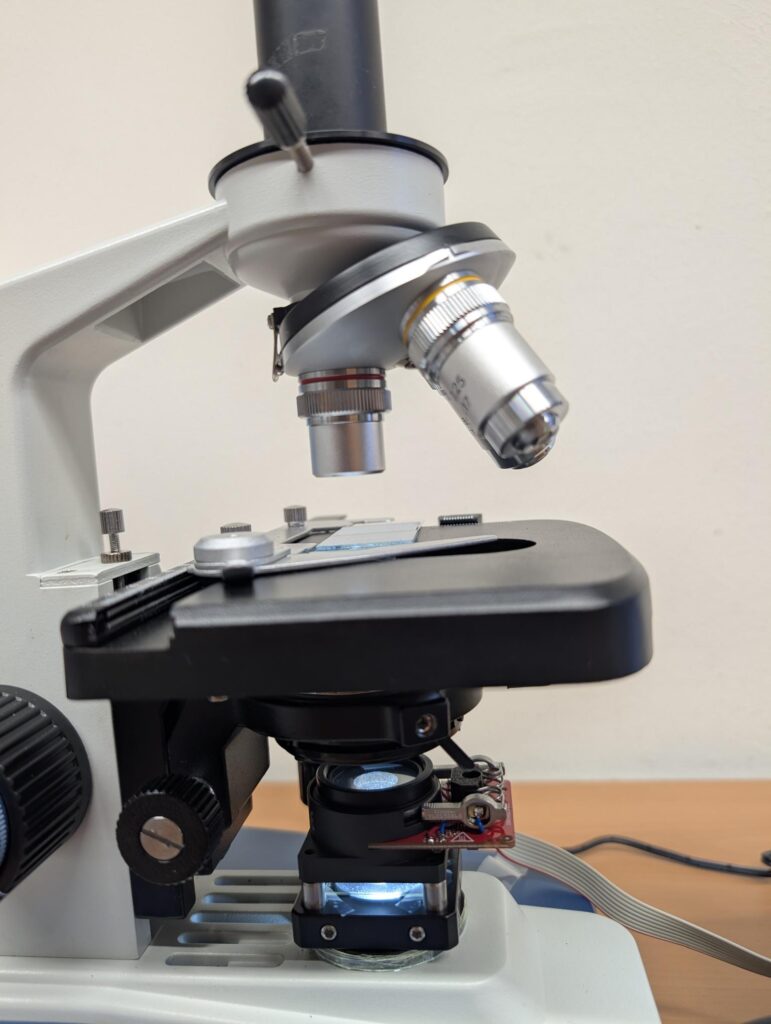
Our recent efforts have focused on making this technology even more accessible by retrofitting a standard commercial microscope into a scientific-grade, highly accurate microscope polarimeter. An affordable microscope can provide outstanding polarimetric data when properly adapted. In this case, we modified an instrument costing less than $300 that features a good mechanical skeleton. With our custom modifications, the system achieves the following:
-
Complete Characterization: It acquires full polarimetric data of transparent samples in the form of Mueller matrices.
-
Simplified Optical Path: The objectives are finite-corrected (not infinity-corrected). For polarimetry, this is a distinct advantage because no tube lens is required, minimizing parasitic birefringence.
-
High-Speed Acquisition: A complete measurement takes just 3 seconds.
-
Uncompromised Precision: All Mueller matrix elements are determined with an accuracy of 0.005 at the pixel level.
-
Automated Correction: Objective strain and residual birefringence are automatically corrected during processing (cheap microscope objectives can be used!).
-
Multi-Wavelength Capability: Three separate Mueller matrices (at different wavelengths) are measured simultaneously.
One of the keys to achive high quality polarimetric data from a simple system lies in how we handle the polarization camera. Instead of relying on the camera’s internal onboard processing, we bypass it entirely. We stream the raw sensor data configured for the lowest noise floor and higher dynamic range and offload the entire computational workload to the computer. This externally optimized processing is what unlocks imaging data quality that rivals state-of-the-art publications.
Below are some photos of our simplest Mueller matricroscope and some experimental measurements.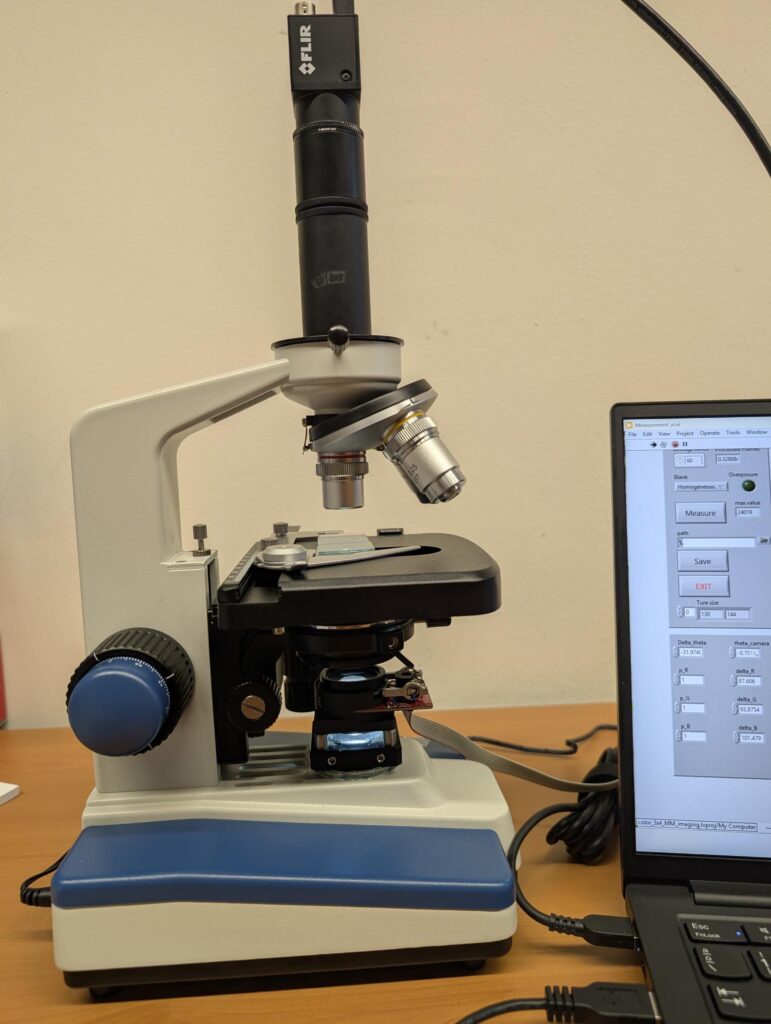
 When some spherulites are measured.

Blank sample measured
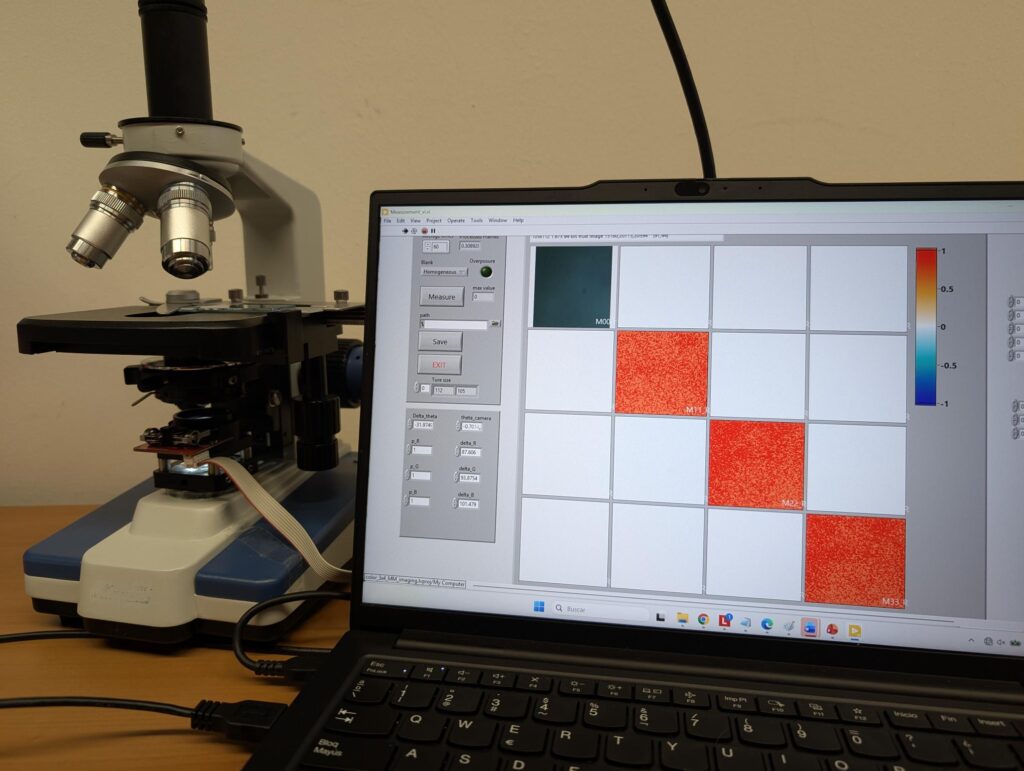
Scaling the normalized MM elements between -0.01 and 0.01 allows checking that the quality is good (here, strain correction is not pixel by pixel).
